Glenn E. Tedford.
Pilot · Tedford Crew (Reddy Teddy) · 328th Squadron · Of Wichita Falls, TX.
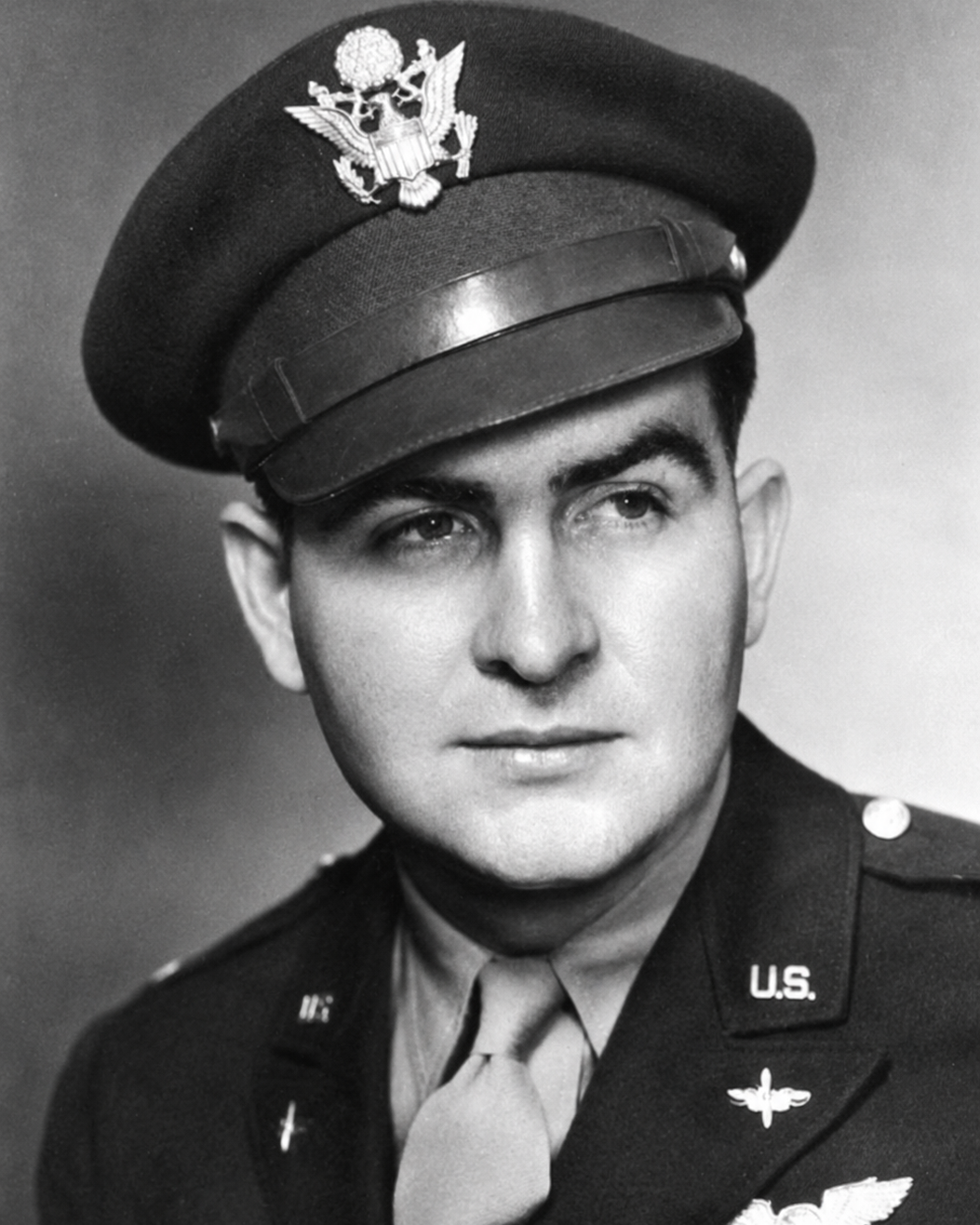
The man.
Glenn Elwood Tedford was born and raised in Wichita Falls, Texas, where he graduated from Wichita Falls High School before enlisting in the Army Air Corps as a private. He earned his wings in April 1943, graduating from flying school at Luke Field in Phoenix, Arizona as part of Class 43-D. He was subsequently assigned to the 328th Bomb Squadron, 93rd Bomb Group, 2nd Bomb Division, 8th Air Force, based at AAF Station 104, Hardwick, England.
Tedford flew the B-24J Liberator designated Reddy Teddy (serial #927), a name given to the aircraft by his crew in his honor. Beginning with his first mission to Emden on December 11, 1943, he would go on to serve as airplane commander on 26 combat missions over occupied Europe, completing his tour on March 23, 1944. His targets ranged from airfields along the French coast to heavily defended industrial centers deep inside Germany, including Frankfurt, Gotha, Friedrichshafen, Munster, and Bordeaux.
Among his most harrowing missions were three attacks on Berlin. His first, on March 2, 1944, was flown in temperatures of 62 degrees below zero, with Tedford leading the second section. His 22nd mission, on March 6, 1944, would become one of the most significant of the entire European air war: the first mass daylight attack on the German capital. Tedford's log of that mission records the brutal reality of the raid in careful, understated detail. Flak over the target was described as coming from 88mm guns and what the crew estimated to be 150mm guns based on the size of the bursts. Fighters pressed the attack during the bomb run and as the formation departed the target. By 13:57, minutes after "bombs away" at 22,000 feet, Reddy Teddy had been hit. One propeller was feathered for good; a second feathered on and off. The aircraft dropped out of formation, losing altitude steadily as Co-Pilot Kenneth Keene called in escort fighters to drive off attacking ME 109s. By 14:12 they were at 18,000 feet, alone. By 15:13, down to 14,500 feet, they crossed the Dutch coast and made for home. Tedford later reflected that the crew could have diverted to Sweden or Switzerland, but chose not to, unwilling to lose the crew. They landed at Hardwick and were sent to southern England for two weeks of rest. The aircraft had two engines replaced before returning to operations.
The solidarity of the Reddy Teddy crew reflected a deliberate decision made early in the tour. After their fourth mission, the men agreed to fly every subsequent mission together. The decision was prompted by the loss of Staff Sergeant W. D. Wahrheit, a tail gunner who had been placed on another crew and was killed when that crew failed to return from a mission. The remaining crew refused to be separated again.
Tedford completed his 26th mission with the 93rd BG on March 23, 1944, a return to the Handorf airfield at Munster, the same target he had struck earlier in his tour. On that day he also received the Distinguished Flying Cross. He had previously been awarded the Air Medal on his fifth mission to Abbeville on January 14, 1944, and subsequently received six Oak Leaf Clusters to that decoration.
Following the completion of his tour, Tedford was transferred to the 448th Bomb Group as Group Training Officer. He flew one additional combat mission on June 6, 1944, D-Day, leading an all-volunteer crew composed of personnel from multiple bomb groups on a strike against Coutances, France. It was his 27th, and final, combat mission.
After the war, Tedford was assigned to Pueblo, Colorado, where he trained Chinese pilots, a duty he later described as nearly as dangerous as flying combat missions. He subsequently helped establish the Air Force Association chapter in Wichita Falls in 1972 and for thirty years, from 1966 to 1996, adopted a squadron at Sheppard Air Force Base, supporting NATO pilots training on T-37s and T-38s. He received a citation from the Air Force for that service.
Glenn Tedford was promoted to Captain shortly after his final combat mission. He passed away on April 26, 1997, in Wichita Falls, Texas.
From the 2nd Air Division Association Yearbook
Joined 93rd Bomb Group at Hardwick, England. Flew first mission Dec. 11, 1943 and completed his 30th mission on March 23, 1944. On March 6, 1944, was almost shot down on a bomb run over Berlin and lost two engines.
Service record.
Missions flown.
Before and after.
Born Jan. 5, 1923 in Wichita Falls, TX. Graduated high school 1940; enlisted at Brooks Field Sept. 13, 1940. Graduated Radio School at Scott Field 1941; went to Lubbock 1942. Pre-flight at Santa Ana, CA; became a flying sergeant. Advanced training at Luke Field, Phoenix, AZ; primary at Hemet, CA; basic at Minter Field, Bakersfield, CA. Graduated as flight officer April 1943; sent to Gowen Field, Boise, ID to fly B-24s and become first pilot.
Transferred to 448th Bomb Group as group training officer after completing 30 missions. On D-Day June 6, flew his 31st mission. Discharged as captain. Received Distinguished Flying Cross and six Air Medals. Married Sept. 16, 1944 to Katherine Foster; one son Walter, two granddaughters. Sales and service manager; traveled worldwide; vice president and half-owner of a company with 235 employees before selling.