Ben Kuroki.
Engineer / Top Turret · 409th Squadron · Of Hershey, Nebraska, NE.
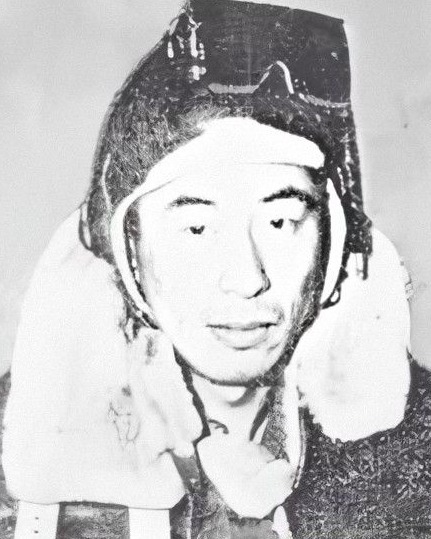
The man.
Early Life and Enlistment
Ben Kuroki grew up on a farm a mile north of Hershey, Nebraska, a small town of about 500 people where his family had lived since 1928. Two days after Pearl Harbor, he and his brother Fred drove 150 miles to Grand Island, Nebraska, to enlist in the Army Air Force. After weeks of confusion and delays, they were finally accepted at North Platte and sent to Sheppard Field, Texas, for basic training.
Discrimination and Persistence
From the outset of his Army career, Kuroki faced intense racial prejudice as a Japanese American. At Sheppard Field his brother Fred would come back to barracks at night and cry. At Barksdale Field, Louisiana, Kuroki was the last of 40 clerks assigned and spent most of his time on KP duty, earning the nickname "Keep 'Em Peeling Kuroki." He was nearly left behind when his squadron moved to Fort Myers, Florida, and again when the group shipped overseas. Each time, through direct appeals, he managed to stay with the unit. As he would later say: "I had a couple of strikes on me to begin with, and I was going to be fighting two battles instead of one — against the Axis and against intolerance among my fellow Americans."
Combat Service in North Africa and Italy
After applying repeatedly for combat duty, Kuroki was assigned to Maj. J.B. Epting's crew in Brig. Gen. Ted Timberlake's 93rd Bomb Group, known as "Ted's Traveling Circus." He flew his first mission as right waist gunner over Bizerte on December 13, 1942, two days after arriving in French North Africa from England. During that mission, tail gunner Dawley was severely wounded by flak; Kuroki helped pull him into the fuselage and, crucially, prevented a co-pilot from administering a morphine injection for a head wound — a decision that likely saved Dawley's life. The group operated from French North Africa and then the Libyan desert near Tobruk, bombing Rommel's shipping at Bizerte, Tunis, Sousse, and Tripoli. The crew then turned to Sicily and Italy, bombing Naples, Palermo, Messina, and Rome — participating in the first American raid on Rome in July 1943. On one mission over Palermo, temperatures at altitude reached 42 below zero. After an England-to-Africa transit, Epting's crew became lost in cloud over the Mediterranean and made an emergency landing in Spanish Morocco, where they were briefly arrested and interned before the American embassy secured their release and return to England.
The Battle of Ploesti
For the low-level raid on Romania's Ploesti oil fields — his 24th mission — Kuroki was reassigned to the top turret, the position he would hold for the rest of his tour. The crew flew aboard "Tupelo Lass" (named for Maj. Epting's hometown in Mississippi), with Lt. Col. K.O. Dessert as squadron leader and Epting as co-pilot. The raid, flown on August 1, 1943, was considered the most dangerous heavy bombardment mission in history and was officially designated "the Battle of Ploesti." Attacking at altitudes as low as 50 feet through intense flak barrages, exploding 10,000-gallon fuel tanks, and small arms fire, Kuroki watched fellow airmen — including close friends — go down in flames around him. The group commander's plane was hit and, after pulling it as high as he could to give crewmen a chance to jump, he deliberately dove it into the tallest building in Ploesti. Kuroki's crew came through without a scratch. He was awarded the Distinguished Flying Cross for the mission.
Volunteering for Extra Missions
After completing his 25-mission tour, Kuroki volunteered for five additional missions, motivated in part by a desire to support his brother Fred, who was not yet overseas. He flew four of these extra missions from England over Germany. On his 30th and final mission over Münster, a flak shell exploded directly above the glass dome of his top turret. The explosion smashed the dome, ripped off his helmet, goggles, and oxygen mask, and threw him against his seat. He briefly lost consciousness from oxygen deprivation. The radio operator and engineer pulled him out of the turret and fitted him with an emergency mask. He escaped without a scratch. For his full tour of 30 combat missions he was awarded a second Distinguished Flying Cross and the Air Medal with five oak leaf clusters.
Return Home and Advocacy
Kuroki left England on December 1, 1943, and arrived in New York on December 7 — two years to the day after Pearl Harbor. On February 4, 1944, he addressed the Commonwealth Club of San Francisco, delivering a speech that became one of the most widely circulated accounts of Japanese American service in the war. The Japanese American Citizens League reprinted it for national distribution. In the weeks before the speech he was based at the Redistribution Station in Santa Monica, giving interviews to Time magazine and broadcasting on national radio. Despite his medals and his record, he continued to encounter racial prejudice. He applied for duty with a B-24 group in the Pacific theater, determined, as he put it, that his combat career would not be over until he had fought in the Pacific.
Post-War Life
After the war Kuroki studied journalism at the University of Nebraska. He spent ten years in Michigan, publishing weekly newspapers in a small town near East Lansing. He then moved to Ventura, California, where he worked for the daily paper (circulation approximately 45,000), eventually serving as news editor before retiring in the early 1980s. He married Shige, originally from Pocatello, Idaho; they had three daughters and three grandchildren. In 1987 items from his collection were included in a Smithsonian Institution exhibit on Japanese Americans and the U.S. Constitution. In a 1986 letter to former crew member Don Hanlon, he described retirement as "semi-retirement" — playing golf twice a week and attending horse racing at Hollywood Park, Santa Anita, and Del Mar.