“Reddy Teddy”
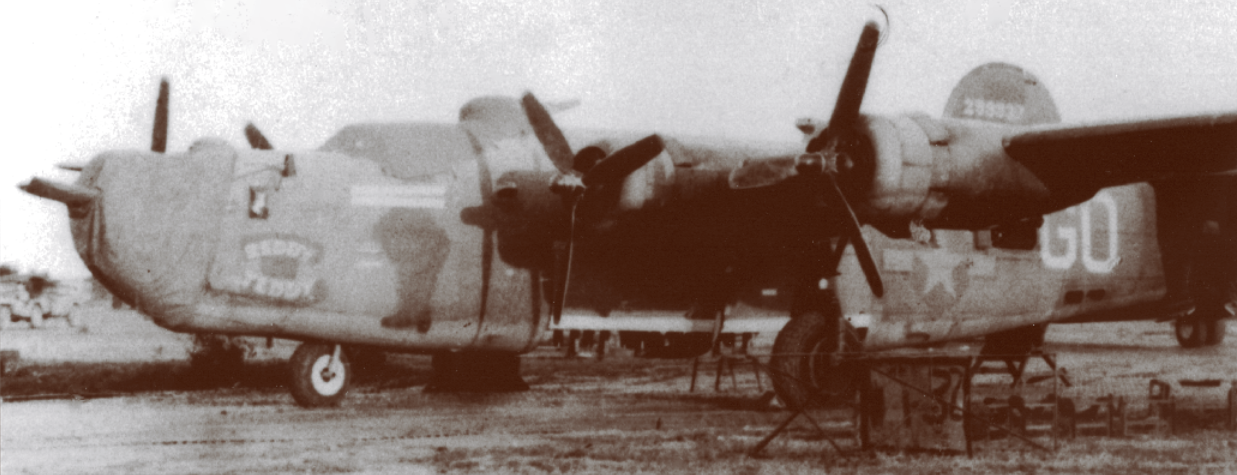
Reddy Teddy was a B-24J Liberator assigned to the 328th Bomb Squadron, 93rd Bomb Group, based at AAF Station 104, Hardwick, England. The aircraft carried serial number 927 and was named by its crew in honor of their pilot, First Lieutenant Glenn E. Tedford of Wichita Falls, Texas, a play on his surname that also captured something of the crew's spirit going into combat.
The aircraft entered operational service with the 328th Bomb Squadron in December 1943 and flew its first mission on December 11, 1943, to Emden, Germany. From that point forward, Reddy Teddy became the dedicated aircraft of Tedford's crew, who made a deliberate decision after their fourth mission to fly every subsequent sortie together and in the same plane. That loyalty was forged partly in loss: Staff Sergeant W. D. Wahrheit, the original tail gunner, had been placed on a different crew and was killed when that aircraft failed to return. The remaining men refused to be separated again, and Reddy Teddy became the physical expression of that bond.
Over the course of Tedford's tour, the aircraft flew missions to some of the most heavily defended targets in occupied Europe, including industrial centers at Frankfurt, Gotha, Friedrichshafen, and Munster, airfields along the French coast at Abbeville and Bordeaux, and submarine infrastructure at Emden and Kiel. The aircraft made three separate trips to Berlin, the deepest and most dangerous penetrations of the German Reich available to 8th Air Force crews.
The most severe test of the aircraft came on March 6, 1944, during the first mass daylight attack on Berlin. Flak over the target was intense, with crews estimating that in addition to standard 88mm batteries, the Germans were employing heavier guns based on the size of the bursts. Reddy Teddy was hit in the target area. Two engines were damaged: one was feathered permanently, the second intermittently. The crew managed to transfer fuel to restore partial power, but the aircraft fell out of formation and began a slow, vulnerable descent across Germany and the occupied Netherlands. Fighter escort was called in to hold off attacking ME 109s as the aircraft lost altitude mile by mile, crossing the Dutch coast at 14,500 feet before making it back to England. The crew weighed diverting to neutral Sweden or Switzerland but chose to bring the aircraft home rather than lose the crew to internment.
After the Berlin mission, Reddy Teddy was taken out of service for two weeks while its crew rested in southern England. Both damaged engines were replaced before the aircraft returned to combat operations. It subsequently flew missions to Friedrichshafen and back to Berlin before Tedford's tour concluded on March 23, 1944, with a strike on the Handorf airfield at Munster.