“Heavenly Daze”
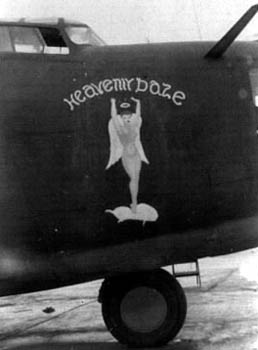
By early 1944, Heavenly Daze was a well-worn veteran, patched repeatedly from missions to Vegesack, Danzig, Oslo, Bremen, Kiel, Brunswick, and other targets. Her regular pilot, Lieutenant Walter McCartie, called her 'a wonderful ship.' On the morning of January 31, 1944, with Lieutenant Richard J. Pettit at the controls in McCartie's place, the aircraft suffered a cascade of engine and electrical failures shortly after takeoff for the No-Ball target at Siracourt. Climbing above an overcast that hid the English coast below, Pettit radioed Hardwick Control for guidance; unable to jettison bombs over populated ground or land with an 800-foot ceiling, he was told to trim the aircraft, send it out to sea, and have the crew bail out. Every man escaped safely by parachute.
Freed of its crew, Heavenly Daze leveled off and continued to fly on its own for more than ninety minutes, its engines settling into a steady drone that puzzled listeners on the ground below. Because its electrical failure had knocked out the IFF identification signal, the Royal Observer Corps and ground radar could not confirm the aircraft's identity, and several Spitfires were scrambled to investigate. Once satisfied no one remained aboard, the RAF pilots made repeated firing passes, discovering that an unmanned, bomb-laden Liberator was not an easy kill; one Spitfire exhausted its ammunition before the bomber finally went down in the North Sea, its wings shot away. Crew chief Sergeant Raymond L. Bader, who had cared for the aircraft on the ground, said afterward, 'She was a great ship... She'd never let anybody down, though.' The loss went unmentioned in that night's BBC broadcast.
Lieutenant Richard J. Pettit, who had piloted the original Heavenly Daze during its bizarre unmanned final flight in January 1944, was flying a Liberator marked 832-N on the March 16, 1944 mission to Friedrichshafen. Sighted in formation near Beauvais and later attached to a group from Bungay, Pettit's aircraft took flak damage and, unable to make it back to England, turned for nearby Switzerland. He and his crew landed safely and were interned there for the remainder of the war.