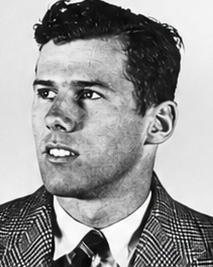
Crew Roster · Personal File
Peter Scott
Serial No. O-772526

Peter Scott

Co-Pilot · Hughes Crew · 330th Squadron

Peter Scott flew as co-pilot alongside Walter Hughes, and the bond they developed went beyond professional trust. Hughes would later write that they had worked together long enough that he knew exactly how Scott thought and how he approached any situation — that he could rely on him completely. The Memoir of Walter F. Hughes is dedicated to him.

Scott had a quiet generosity about him. He and Ralph Hendershot went in together on a tandem bicycle and rode it around the base. He lent Hendershot $60 at some point — money that was never repaid, and that eventually bought a crib for Hendershot's son, a child Scott would never meet.

He was killed on November 21, 1944, over Hamburg, on the crew's 15th combat mission. A piece of flak roughly three-quarters of an inch across, traveling at nearly half a mile per second, came through the cockpit at the moment of bombs away. It found the one small gap in his flak vest — the angle of the clavicle at the top of his shoulder — severed the right subclavian artery, and exited through his back, where it lodged in his packed parachute. He was gone in under a minute.

That morning, Hendershot remembered seeing Scott standing outside against the building before the mission. Scott mentioned, almost offhandedly, that he and some others hadn't been required to fly that day. Hendershot recalled the moment years later as though Scott had somehow sensed what was coming.

Hughes accompanied his body to the cemetery near Cambridge. Scott left behind a wife named Lois. He was 1st Lieutenant, USAF, and he does not appear in the crew photo taken the following March — his place in the story already sealed by then.

PASSED 21 NOV 1944

Sortie Log

15 CATALOGUED SORTIES
10 SEP 1944 — 21 NOV 1944

The sorties below are those we have been able to document for this airman, drawn from flight logs, mission records, and archival sources. It is not necessarily a complete account of every mission flown; gaps may reflect missing documentation, transferred assignments, or records lost to time.

8AF Mission
Date
Target
Aircraft
№ 619
10 SEP 1944
HeilbronnM/Y
On the evening of September 9th, the group was alerted once again. Crew 94-C was on the list, and with it came the weight of what that meant. Only a day or two earlier they had been alerted and arrived too late to enter the fight. Now they had their orders, and the reality of a first mission settled in. The feelings were tangled: a sense of purpose, a desire to do their part, and the quiet, persistent awareness that they might not come back. Standard practice was to assign a new pilot to fly with an experienced crew while a seasoned pilot took over his aircraft. But this crew had been with the squadron for three weeks and knew the routines well enough. They flew together on their first mission, with one exception: a different bombardier filled the position. Wake-up came four hours before takeoff. The squadron orderly moved through the barracks that night, rousing each man scheduled to fly, along with one or two alternates in case a listed crew couldn't go. The mechanics of flying a mission were by then well drilled, and the crew moved into their assigned position without difficulty. The mission itself was another matter. Crossing the Rhine somewhere between Frankfurt and Cologne, a four-gun antiaircraft battery of 88mm guns found them. The first burst detonated roughly a hundred feet off the left side. The next came off the right. The flak grew so dense that the lead group disappeared behind a curtain of black smoke ahead, and then they were in it themselves. Bursts came between the aircraft and the ship flying alongside. There was nothing to do but hold course. The crew landed and reported to Major Brutus "Pop" Hamilton for intelligence debriefing that afternoon. Hamilton, whom the pilot knew from his days as football coach and athletic director at the University of California, Berkeley, received a quiet group. Mission records noted 10 x 500-pound incendiaries dropped on a jet plant target, moderate flak, no enemy fighters, and all planes returned with one flak hole. The navigator's log told the route in full: in over the coast at Hautbano, across San Quentin and Allied lines at Nancy, over the Rhine south of Strasbourg. The primary target at Günsburg was not reached; bombs fell on a target just north of Stuttgart. The return leg passed over Speyer, Kaiserslautern, Reims, and Cambrai. In all, 1,300 nautical miles.
Ack Ack Shack42-94970
№ 623
11 SEP 1944
MagdeburgO/I
The second mission took the crew to Magdeburg. After leaving the target area the formation scattered, and though jets were spotted, none pressed an attack. The flak over the target was another matter: intense, accurate, and in volume. The lead group took the worst of it. Flying behind them, the crew watched as the bombs went away and then, almost immediately, three aircraft were hit and burning. They watched as the ships went down, trying to count parachutes. One aircraft had its bomb bay blazing like a torch. Only three chutes came out of it. Then a fourth man fell through the flames. Another, unable to get out through the bomb bay, climbed through the top hatch and came out nearly into the arc of his own aircraft's propeller. For a moment it seemed he wouldn't clear it. He did. He slipped past the tail and dropped away until his parachute opened in the sunlight below. Between two of the three ships, nineteen chutes were counted, with perhaps one man unaccounted for. The third ship accounted for an estimated six. Ralph later wrote: "I'll never again fail to return home, to count the holes, and try to get some sleep before tomorrow's mission." Their own aircraft came back without a flak hole and the crew unhurt. The navigator's log recorded the route in: Ostende, Ghent, Brussels, Liège, Cologne, Bonn, Giessen, Brunswick, and on to the target. Heavy flak was noted over Cette and Hannover as well. The return leg passed Nienburg, Dümmer Lake, and out over the Zuiderzee. By the log's count, 150 guns were active over the target and considered very accurate. Three ships lost. Twenty-nine men unaccounted for, nineteen confirmed to have bailed out. One aircraft had aborted before the target. Bombing results were recorded as poor, the target missed.
Pis-s-st42-95242
№ 626
12 SEP 1944
HemmingstedtO/R
The third mission came the very next day, September 12th. The target was a small oil refinery at Hemmingstedt in Schleswig-Holstein. Pete Scott didn't fly; he had been assigned Officer of the Day. The route took the crew up the North Sea, bombing south to north, which put them heading toward the Frisian Islands on the way home. A few bursts came up from Heligoland, but no flak reached them and no fighters appeared. All aircraft returned without damage. Five of the six refinery buildings were assessed as destroyed. It was, by the crew's own reckoning, the easiest mission of the early tour.
Pis-s-st42-95242
№ 650
27 SEP 1944
Kassel/Henschel??
The fourth mission was to a tank factory at Kassel, September 27th. The route in passed Egmond, Amsterdam, Apeldoorn, and Münster before reaching the target. Flak over Münster and Kassel was heavy, though inaccurate. Their aircraft came through without damage. The formation flying behind them was not as fortunate. Fighters struck the 458th Bomb Group in the rear, and 28 bombers were lost. The crew watched it happen from ahead in the formation. The return leg ran south through Göttingen, Giessen, Frankfurt, Wiesbaden, and Koblenz, then back out over Liège, Ghent, and Ostende. Bombing results were recorded as undetermined, relying on PFF equipment through the overcast. All crew returned safe.
XX-XX396
№ 659
02 OCT 1944
HammM/Y
Mission five took the crew to the marshalling yard at Hamm. The route followed a now-familiar path: in over the coast at Egmond, past Amsterdam, Apeldoorn, Enschede, and Münster to the target. The return ran through Gütersloh, Bielefeld, and Osnabrück. Flak was heavy at the coast coming and going, at the target, and at three points along the route. The official report noted no flak holes. The navigator's log told a different story: seven hits, a thirteen-inch tear in the bomb bay, three holes in the tail, two in the wing, and one in an engine. All crew returned safely. No fighters were encountered. The PFF bombing results were recorded as a hit on the target, though not a clean one.
XX-XX898
№ 665
05 OCT 1944
PaderbornA/F
The sixth mission was a comparatively straightforward one. The target was an airfield at Paderborn, and the route in followed the familiar track over Egmond, Amsterdam, Apeldoorn, and Osnabrück. Flak came up at Osnabrück and Bielefeld but nothing reached the formation over the target itself. Passing near Bad Oeynhausen, the crew counted 25 barrage balloons floating above the railroad bridge over the Weser River. Bombing conditions were good, with clear visual sighting across a formation of 750 aircraft. Results were assessed as very good. The aircraft, "Solid Comfort," came back without a mark. No fighters, no flak holes, all crew safe.
Solid Comfort42-50501
№ 667
06 OCT 1944
Harburg Rhenania EbanoO/I
The crew had been to Hamburg once before, on October 6th. That first time, the 2nd Air Division had tried something different: 450 aircraft split into three-ship formations and approached the target from every direction. It made little difference. The Hamburg gunners tracked each flight individually regardless, and with 150 separate formations in the air, they simply divided their attention accordingly. Bombing results that day were reported as poor. This return visit followed a more conventional approach. The route came in over Nordholz, past the North Weser estuary, Bremen, Verden, Nienburg, and Harburg, with the exit back out over the Frisian Islands. Smoke pods were visible around Bremen, Hamburg, and the mouth of the Kaiser Wilhelm Canal. Over the target, 230 88mm guns were active and the flak was intense. Cloud cover at 10/10ths obscured any view of the results. Ralph flew with another crew that day, testing an all-glass enclosed nose configuration. With no bombardier aboard their own aircraft, Hughes handled the bomb drop himself. Ten 500-pound GP bombs went down into the overcast. The aircraft came back with a large hole in the left side and a fair chip out of the number three propeller. All crew returned safely. Elsewhere in the formation, three men had bailed out.
Miss Star Dust42-100355
№ 674
12 OCT 1944
OsnabrückM/Y
Miss Star Dust42-100355
№ 676
14 OCT 1944
Kaiserslautern??
The ninth mission took the crew south to the marshalling yards at Kaiserslautern. The formation assembled over London and crossed the coast at Boulogne, tracking through Lens, Douai, and Valenciennes to the target. The return ran out through Luxembourg, Trier, Mons, and Ostende. Flak was meager but accurate on the bomb run. Cloud cover was complete and Hughes again handled the bomb drop without a bombardier. Whether the bombs found the yards was impossible to say. The aircraft came back clean, and all crew were safe. Elsewhere in the formation, three men had bailed out.
Miss Star Dust42-100355
№ 700
04 NOV 1944
Hannover/MisburgO/I
The tenth mission was to an oil refinery at Hannover, though the crew remembered it as Merseburg, one of the most heavily defended targets in Germany. The route went out over water to Cuxhaven, then Bremen, Lüneburg, and Cette before reaching Hannover. The return passed Dümmer Lake, Zwolle, and Alkmaar. Flak in the Frisians on the way in was meager, but over the target it was intense. The crew later recalled 155mm guns sending up enormous bursts that broke the formation apart before bombs away. Hughes released the bombs. Weather intervened and they missed the target by a mile. Four flak holes in the aircraft; no ships or men lost. From November 4th the missions came rapidly, five in seven days. It was, as the crew described it, their greatest period of strain. They were weary, tired almost beyond endurance.
Ack Ack Shack42-94970
№ 702
05 NOV 1944
KarlsruheM/Y
Mission eleven carried the crew to the marshalling yards at Karlsruhe. The route came in over Camiers, through Laon, Nancy, and Luxembourg to the target, returning by way of Stuttgart, Lille, and Ostende. Hughes flew on the flight deck. Over the target the flak was heavy, the crews noting bursts in red, white, and black. Cloud cover was complete and results could not be observed. Three 2,000-pound bombs went down through the overcast. One aircraft was lost and three men with it; seven others had bailed out elsewhere. Their own aircraft, "Maulin Mallard," returned without damage and all crew safe.
Maulin Mallard42-109867
№ 704
06 NOV 1944
Minden/Mittelland Canal??
The twelfth mission targeted the canal locks at Minden. The route came in over the coast, through Zwolle, Hengelo, Münster, and Lemgo. The return passed Steinhude Lake and Dümmer Lake. Hughes again flew on the flight deck. Mobile flak was active at Münster and Osnabrück along the route, though none reached the formation over Minden itself. Three jets were spotted in the area. Four aircraft were seen going down. All 93rd Bomb Group ships returned, with one flak hole in the bomb bay. Crew safe.
Joker, The44-40472
№ 707
09 NOV 1944
MetzT/T
Mission thirteen took the crew to Fort L'Asnée in France, in support of ground operations near Metz. The bombs were 2,000-pounders, the largest the crew had carried. They were too large for the bomb bay and were suspended instead on remote toggles under the wings, inboard of the number two and three engines. When they released, the aircraft lurched upward with the sudden change in weight. The target sat close to Allied lines, and elaborate precautions were in place. American ground troops fired red smoke along their front line so the formations could see exactly where friendly positions ended. It worked, though the crew couldn't help thinking through what might happen if the markers failed to ignite at the right altitude and kept climbing. The concern was not abstract. In an earlier incident involving a similar close-support mission, bombs had fallen on American troops. The lead pilot in that case had been arrested on landing. Flak was meager and no enemy fighters appeared. One aircraft was lost. Their own ship came back clean. Patton's push toward Metz began the following morning.
Joker, The44-40472
№ 709
10 NOV 1944
Hanau M/YM/Y
The November 10th mission went to the marshalling yards, with the navigator's log recording the target as Hanau rather than Hamm. Hendershot was in hospital and did not fly. The route formed near London, crossed the coast at Calais, and tracked through Lille, Charleroi, Liège, and Koblenz to the target. The return ran out through Frankfurt and Ghent. Flak came up at Koblenz on both legs and again over Frankfurt and the target, though cloud cover at 10/10ths obscured any view of results. A jet was spotted in the area. No ships or men were lost. After the mission the crew was stood down and given a short leave in London.
Miss Star Dust42-100355
№ 720
21 NOV 1944
Hamburg/Dpag??
The crew returned from their London pass to find the weather holding them on the ground until November 21st. At briefing that morning, the target was announced: Hamburg. The briefing officer was direct. The formation would be within range of 446 guns, seven minutes before bombs away and nine minutes after. The course ran up through the Frisian Islands, past Heligoland, a sharp turn toward Hamburg, then a right turn south after Bremen, veering east around the city, north of the Danish peninsula, and back out over the North Sea. As they turned in from the sea at Cuxhaven there was not a cloud in the sky. They were in the third position in the high right when the flak found them. It was thick enough that the lead group disappeared behind its own curtain of smoke. Bursts came between aircraft flying in formation. Then the bombs went away and the formation began a slow right turn. At that moment a burst detonated close enough to shake every sense at once. The pilot glanced at Pete Scott in the co-pilot's seat. Pete looked back, apparently unaware he had been hit. There was nothing in his expression except surprise. Then he began to slump forward into the controls. The crew disengaged Pete's radio, oxygen tube, and safety belt and pulled his flak vest. The ship flew itself most of that time, and by the time they had him clear they were well separated from the group, which they never found again. Conway climbed into the co-pilot's seat. Eck radioed ahead. The pilot put the aircraft into a shallow dive and pushed airspeed to 240 mph. Over the base, Ralph fired emergency flares. No one saw them. The message Eck had sent hadn't reached the tower, and the group hadn't returned yet. The tower assumed they had aborted before the target. The pilot parked on the taxiway and called for a doctor and an ambulance. Doc Steinbeck arrived and asked how many and where. Then they took Pete out of the plane. With no one available to move the aircraft, the pilot taxied it to the hardstand himself. They had beaten the group home by 45 minutes. Doc Steinbeck sent someone along with the pilot to get him through debriefing and to the hospital. On the flight home his face and right arm had begun to burn; fine particles of Plexiglas had passed through his oxygen mask and clothing and into the skin. Conway later explained what had happened. The flak had clipped the right subclavian artery, close to where it branches from the aorta. Pete had bled to death in under a minute. The wound was nearly impossible to find because of the angle: a small gap at the top of the shoulder where the flak vest didn't cover. The fragment was nearly three-quarters of an inch across. Hendershot recalled that before they left the hut that morning, Pete had been standing outside against the building, remarking that he and two others didn't have to fly that day. The aircraft, "The Joker," took an estimated fifty to sixty hits and nearly lost its right wing. It came home alone, north of course, through flak most of the way. Pete Scott was buried at Cambridge American Cemetery. The pilot accompanied the body on the drive out from the base. He described the cemetery as one of the finest he had ever seen, set in quiet green grounds with a small stream in the valley below a chapel. Halfway up the path, a work detail of German prisoners was clearing leaves. As the pilot approached, their leader called them to attention. He could not bring himself to return the salute. His hand shook so badly he could barely sign his name on the chaplain's document. After the mission, Dr. Steinbeck refused to certify the crew for flight until they had rested. They were sent to recuperation and did not return to duty until December 13th.
Joker, The44-40472