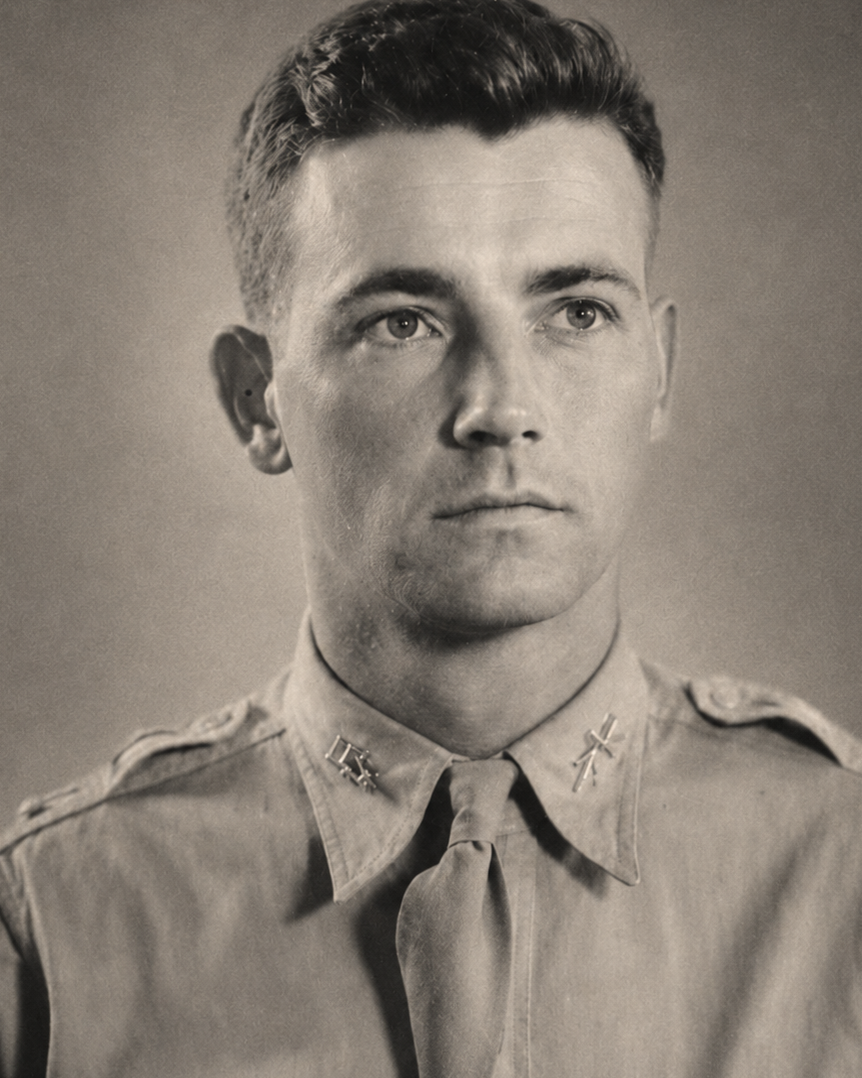
Edward L. McGuire
Edward L. McGuire, Jr., known to friends and crewmates as "Ted," grew up in the Boston, Massachusetts area, where a fascination with military service took hold during four years of high school cadets from 1928 to 1932. His ROTC instructor, Major Danforth, sparked in him a deep desire to earn a commission, and McGuire sought entry to West Point, Annapolis, and the Massachusetts Nautical Training Ship School in turn, only to be refused by his parents each time. They enrolled him instead at Boston University, where he joined the ROTC under Colonel Ganoe and was elected to Scabbard and Blade, the honorary military fraternity, during his junior year. A youthful romance that year left him on academic probation, but he recovered to earn a near-Dean's List average as a senior. Through the guidance of an ROTC instructor, he attended the Civilian Military Training Camp at Fort Devens, and in April 1940 he was commissioned as a 2nd Lieutenant in the Infantry Reserves.
In February 1941, McGuire was ordered to duty with Air Force troops at Dale Mabry Field in Tallahassee, Florida, where he candidly told the commanding officer he had not known the Air Corps existed until the week prior. Assigned as assistant supply officer under the famously thunderous Captain Harold Orr, he quickly proved his resourcefulness. When General Hap Arnold personally ordered a stand of private pine trees removed from a runway approach during a surprise inspection, McGuire resolved the problem within days, persuading the landowner to donate the timber and the local WPA office to furnish the labor. He also diagnosed a massive fly infestation by kicking open the surface crust of runway embankments and discovering miles of maggot-filled sludge beneath. These accomplishments earned him a place at the Air Adjutant School at the War College in Washington, and upon his return he served as Assistant Base Adjutant under then-Captain William G. Lee, building the administrative experience that would serve him throughout his career.
The summer of 1941 brought McGuire to Shreveport, Louisiana, when he was tasked with leading a convoy of fuel trucks and mobile repair vans to the Louisiana Maneuvers Area. He completed in three days a trip the Army had planned for seven or eight, and arriving in Shreveport he was struck by the large cross dominating the head of Texas Street and the live-oak-framed courthouse, sensing in the city an orderliness and stability he had never felt before. On the evening of September 5, 1941, he attended a party at First Presbyterian Church and met Mary Evelyn Bell, a Shreveport native. Three weeks of courting followed, and the two decided quickly to marry. The union endured more than four decades, and each night from their first night of married life onward, they closed the day lying in each other's arms and saying the Lord's Prayer aloud together.
Driven by the need to support his young family and a desire for command, McGuire sent a personal telegram directly to General Hap Arnold requesting flight training in grade, a new provision allowing commissioned officers to train as pilots without first resigning their commissions. He was promptly ordered to Maxwell Field and enrolled in Class 42-F. Primary training at Dorr Field in Arcadia, Florida, under civilian instructor A.J. Mertens gave him a lasting love of split-S maneuvers and spins, and a reckless excursion into wildfire smoke over Lake Okeechobee instilled a deep and permanent respect for instrument flying. Basic training at Bush Field in Augusta, Georgia, and advanced twin-engine training at Moody Field in Valdosta followed in rapid succession. On July 3, 1942, McGuire received his wings as a rated USAAF pilot, transitioning from 2nd Lieutenant of Infantry to 2nd Lieutenant of the Army Air Forces Reserve.
Returning to Moody Field as an instructor pilot teaching British cadets, McGuire was then sent to the Instructor Pilot's School at Maxwell Field under Lieutenant Guy M. Jones, an experience he credited with transforming his flying from competent to exceptional. He went on to George Field, Illinois in October 1942, serving first as an instructor and then as Engineering Officer of the 709th Technical Squadron. With roughly 180 men and 25 AT-9 twin-engine trainers in his charge, he abolished the closed-door policy in his office, required mechanics to bring him every broken part alongside its replacement for shared analysis, and held regular open forums where any man could raise a concern or suggestion. In the spring of 1944 he also served as Test Pilot for the entire field, a role that produced several near-fatal emergencies, including a crash landing in Pittsburg, Pennsylvania while nearly out of fuel in dense clouds, and a near-stall on takeoff caused by an undetected elevator trim tab failure that only the quick strength of his crew chief prevented from becoming fatal. When he was relieved of the test pilot duty, the field replaced him with three WAAFs and four second lieutenants.
In early 1944, McGuire transitioned to B-24 Liberators at Berry Field in Smyrna, Tennessee, where his old classmate Stevens pushed him relentlessly through single- and multiple-engine emergencies, including feathering three of four engines during a takeoff roll. He assembled his crew at Westover, Massachusetts and completed RTU training at Charleston, South Carolina. On September 3, 1944, the crew departed Langley Field, flying the northern ferry route via Maine, Labrador, Greenland, and Iceland before landing at Valley, Wales on September 19. They arrived at Hardwick Airfield by train on September 23, 1944, officially joining the 93rd Bombardment Group (H), 409th Squadron, 20th Combat Wing, 2nd Air Division, 8th Air Force.
At Hardwick, Colonel Therman Brown assigned McGuire to fly the group's war-weary aircraft so that younger pilots could have the more reliable planes. His crew included co-pilot 2nd Lt. Victor Hanf, Jr., navigator 2nd Lt. Charles Sill, bombardier 2nd Lt. Joseph Dondero, flight engineer S/Sgt. Cornelius "Bill" Leach, nose gunner S/Sgt. Theodore Szajna, tail gunner S/Sgt. Barney Eller, waist gunners S/Sgt. William Gardner and S/Sgt. Edward Powell, and radio operator S/Sgt. Donald South. On his very first mission to Lippstadt on October 5, 1944, his aircraft was rolled inverted by propwash on the bomb run; he and check pilot Captain Kenneth Gilbert recovered it and released the bombs far from the target, returning to find themselves posted as missing in action. McGuire and his crew would be posted MIA two more times before the tour ended.
Over the winter of 1944 to 1945, McGuire flew into the most heavily defended targets in Germany: Hamburg three times (briefed for 500 anti-aircraft guns each time), Merseburg's oil refinery, Cologne, Magdeburg, Nuremberg, and finally Regensburg on April 21, 1945. A signature incident came on the Cologne mission in October 1944, when bomb bay doors frozen shut in the extreme cold refused to open over the target. McGuire drew his .45 pistol, counted to three over the intercom, and the bombardier put the bombs through the doors. On Mission 3 to Osnabruck in October 1944, he lost an engine and directed Leach and two crewmen to crank the main landing gear down by hand in the open bomb bay, without parachutes, then landed at Hardwick without a nose wheel and skidded off the runway until the tail skid was ground away. A formal accident board ultimately endorsed his decision to complete the landing rather than risk a go-around.
Flight engineer Cornelius "Bill" Leach was the unsung heart of the crew. He stood in the bomb bay hatchway on every bomb run to hold the doors open manually and ensure all bombs cleared, and on multiple occasions demonstrated the extraordinary courage that McGuire believed had earned the crew the Distinguished Flying Cross at least three times over. McGuire and co-pilot Hanf also devised a technique to reverse the fuel transfer pump and dump gasoline overboard on recalled missions, cutting the standard two-hour holding orbit to a fraction of that time, and they developed a landing method that cut all four engines to idle at touchdown, stopping the heavy Liberator far shorter than any other crew on the field. Despite these achievements, a formal DFC recommendation was never made, a circumstance McGuire attributed to the politics of the war-weary plane assignment and an above-average abort record that was itself a direct consequence of those unreliable aircraft.
Edward L. McGuire, Jr. completed his 36th and final combat mission on April 21, 1945, over Regensburg, and was thrown into a water tank in the traditional end-of-tour celebration. He was promoted to Major and by March 1946 was separated from active duty, returning permanently to Shreveport, Louisiana, where he and Mary Evelyn settled at 852 Kings Highway with their son Edward L. McGuire III. His military career continued until 1953. In retirement, McGuire dedicated himself to preserving the memory of his crewmates and the men of the 93rd Bomb Group, eventually writing his memoir titled "Hello Milfoil... This Is Wee Willie," after the radio call signs of his home airfield and his aircraft. The memoir, completed and copyrighted in 1983, was presented to the 2nd Air Division Memorial Room at Norwich Central Library by Phillip Day in memory of McGuire, and stands as a vivid first-person record of one of the most storied heavy bombardment groups of the Eighth Air Force.
Sortie Log
05 OCT 1944 — 21 APR 1945
The sorties below are those we have been able to document for this airman, drawn from flight logs, mission records, and archival sources. It is not necessarily a complete account of every mission flown; gaps may reflect missing documentation, transferred assignments, or records lost to time.
Edward L. McGuire, Jr. grew up in the Boston, Massachusetts area, where four years of high school cadets (1928–1932) and ROTC studies at Boston University under Colonel Ganoe cultivated a deep desire for military service. After earning his commission as a 2nd Lieutenant in the Infantry Reserves in April 1940, he was ordered to Dale Mabry Field in Tallahassee, Florida in February 1941, where he served as an assistant supply officer and later as Assistant Base Adjutant under Captain William G. Lee. The 1941 Louisiana Maneuvers brought him to Shreveport, where he met and married Mary Evelyn Bell in September 1941. He applied directly to General Hap Arnold for flight training in grade and was enrolled in Class 42-F at Maxwell Field. He earned his wings on July 3, 1942, then served as an instructor pilot at Moody Field, as Engineering Officer of the 709th Technical Squadron at George Field, Illinois, and as Test Pilot for George Field through early 1944 before transitioning to B-24 Liberators.