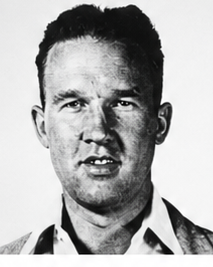
Conway Thorstenson
Conway Thorstenson served as flight engineer and top turret gunner, and over the course of 35 missions he proved to be one of the most capable men on the crew — steady under pressure and deadly accurate when it counted.
On November 21, 1944, the day Pete Scott was killed over Hamburg, Thorstenson climbed down from the top turret and took the right seat to fly co-pilot for the return trip home. He also identified the wound that had killed Scott with enough precision — naming the subclavian artery and understanding its location — to suggest some background in medical training.
He was at his guns on March 25, 1945, when the crew was jumped by ME-262 jets over Buchen/Hamburg, and both the top and waist gunners came away with what the crew called good shooting. On April 4, 1945, he spent forty minutes in continuous fire during a sustained jet attack, with Lee in the nose alongside him. Three days later, on Mission 34 over Geesthacht, a fighter came in from eleven o'clock high — identified by the pilot as an FW-190, though Thorstenson's account noted it as an ME-109. Either way, he brought it down. The German pilot bailed out fifteen seconds later. The kill earned Thorstenson an Oak Leaf Cluster to his Air Medal.
He appears in the crew photo taken March 24, 1945, standing in the top row, third from the right — one day before the Buchen mission. He also appears in a photograph taken at Le Bourget in Paris, alongside Hughes and Windsor. Hughes, for his part, took care in the Memoir of Walter F. Hughes to note that Thorstenson and navigator Lou Windsor were two different people — a distinction apparently worth making explicit.
Sortie Log
10 SEP 1944 — 08 APR 1945
The sorties below are those we have been able to document for this airman, drawn from flight logs, mission records, and archival sources. It is not necessarily a complete account of every mission flown; gaps may reflect missing documentation, transferred assignments, or records lost to time.