Crew Roster · Personal File

Charles W. Walters

Pilot · 328th Squadron
HometownNorth Tonawanda, NY, NY

Walters was pilot of the aircraft. After ordering the crew to bail out, he dived headfirst through the bomb bay at approximately 2,000–3,000 feet. His parachute opened with a jerk, causing him to lose his flying boots, electric shoes, and gloves; the violent opening also badly sprained his back. He landed within 200 yards of the crashed, burning aircraft, near Chartres in farming countryside he recognized as France.

A group of boys directed him to a nearby grove of trees and then two men led him to a farmhouse, where he dried his shoes and was given French workers' clothing. Helpers kept watch through the afternoon. He heard that Germans had begun searching in an ever-widening circle from the crash site. At dusk he cycled with two Frenchmen to a small village where he met co-pilot Lt. Bickley. Later that night they joined Sgts. Hite and Del Guidice.

The group was moved through an organized evasion network via Brou and Paris. They stayed at the home of Dr. Alice Willem in Paris, and later were sheltered in Juvisy-sur-Orge at 29 Rue Roche with André Lefèvre until 27 January 1944. While there they met three other American airmen: Capt. Peter Hoyt (pilot, Cleveland), 2d Lt. William Cook (navigator, Phoenix, AZ), and Dan Hanslik (bombardier, Saginaw, MI). The group eventually traveled south through France to the Spanish border.

Walters crossed into Spain and was questioned at Jaca by military and civil police on 10 February 1944, the same date he arrived in Spain. He signed security certificates in Madrid on 18 February and Gibraltar on 19 February 1944. He was interrogated by British intelligence in Gibraltar and gave a written report. He departed Gibraltar by air and arrived Bristol, UK, on 24 February 1944. He reported his escape publicly after returning home, noting it was 'just a case of a lot of work and a lot of luck.' Walters was a former football player at Temple University and had coached at Union High School, NJ.
Completed Tour
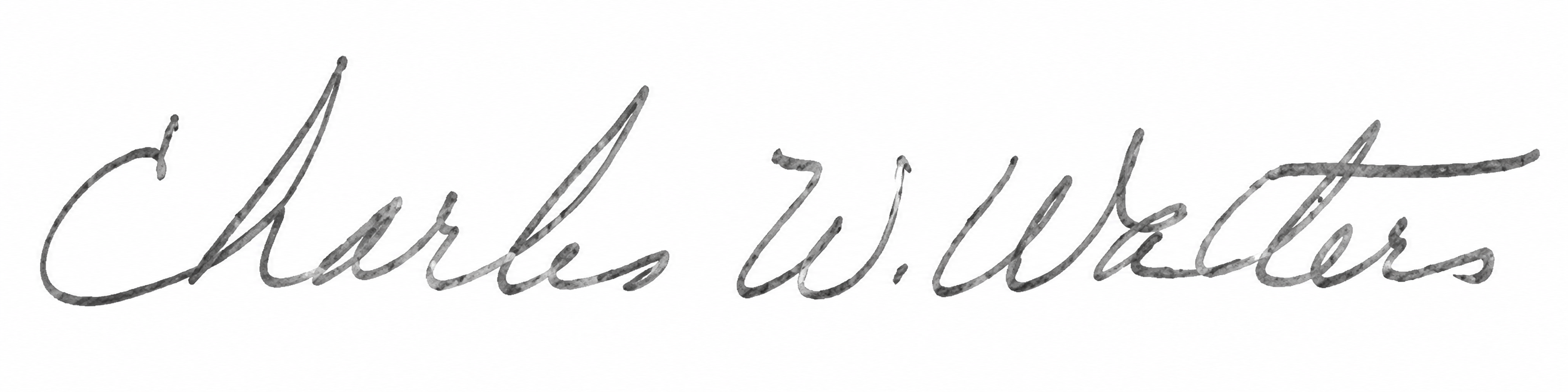
Signature of Charles W. Walters

Sortie Log

2 CATALOGUED SORTIES
07 JAN 1944 — 07 JAN 1944

The sorties below are those we have been able to document for this airman, drawn from flight logs, mission records, and archival sources. It is not necessarily a complete account of every mission flown; gaps may reflect missing documentation, transferred assignments, or records lost to time.

8AF Mission
Date
Target
Aircraft
№ 178
07 JAN 1944
Ludwigshafen
On 7 January 1944 the aircraft departed Hardwick at 07:30 on a bombing mission to Ludwigshafen. While returning from the target the aircraft was attacked by Me 109s in the vicinity of Chartres, France. Engine number two was set on fire and the flames quickly spread to the wing. Pilot Lt. Walters dived the aircraft to 15,000 feet in an attempt to extinguish the fire. When this failed he ordered the crew to bail out and rang the alarm bell. The aircraft was traveling at approximately 200 mph when Walters dived headfirst through the bomb bay at roughly 2,000–3,000 feet. The aircraft exploded on impact with the ground and was completely destroyed. It came down within 200 yards of where Walters landed, near Brou, France, approximately 5–6 miles from Brie. Four crew members — Walters, Bickley, Del Guidice, and Hite — successfully evaded capture and returned to the UK on 24 February 1944. The navigator, bombardier, and three gunners (Kudej, Sweet, and Stainker) remained MIA.
№ 178
07 JAN 1944
Ludwigshafen
B-24D serial 42-40990, assigned to the 328th Bomb Squadron, 93rd Bomb Group, was lost on 7 January 1944 during a combat mission to Ludwigshafen, Germany. The aircraft departed AAF Station 104 and was last seen over the Chartres area at approximately 1320 hours. Loss was attributed to enemy aircraft. No. 2 engine caught fire and the wing behind the engine was also burning. Controls were partially damaged and did not respond fully. The pilot ordered the crew to bail out at between 4,000 and 5,000 feet altitude. All crew members were observed bailing out with parachutes opening. The aircraft exploded before hitting the ground and exploded again on impact. It crashed into a forest near Chateau, approximately 17 km southeast of Foix, France. A German capture report dated 15 February 1944 confirmed the crash location. French witnesses reported that two bodies were found in the burned wreckage. Four crew members — the pilot, co-pilot, radio operator, and engineer/top turret gunner — evaded capture and returned to England together. Two officers, the navigator and bombardier, were assisted by French contacts and reached Paris but were captured by the Germans before reaching Spain. The fate of the remaining three crew members was not definitively established.
On The Ball42-40990