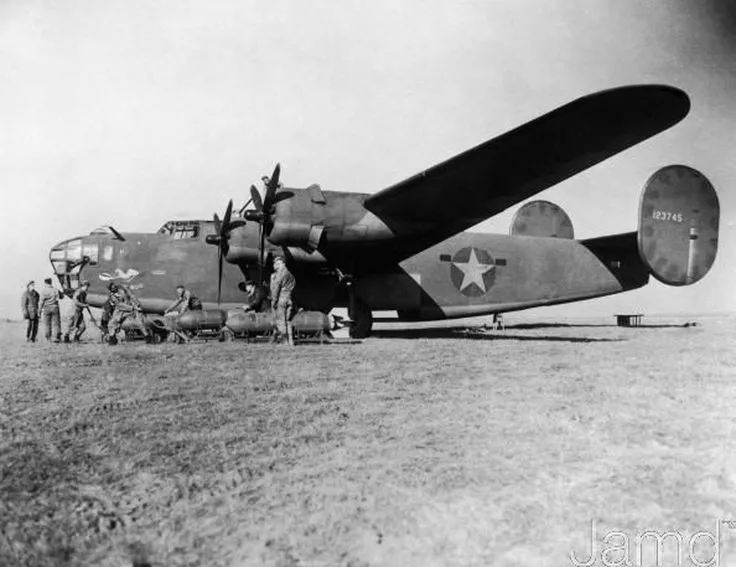
“Katy Bug”
Katy Bug went down on November 18, 1942, returning from the raid on Lorient's U-boat pens. First-pilot Al Asch, newly elevated from co-pilot for what was his first mission in command, took a flak hit under the right wing that ruptured the fuel tanks; gas streamed out for most of the trip home while the crew and well-wishers over the radio tracked the leak. The nose-wheel balked at Alconbury, forcing the engineer and bombardier to wrestle it down by hand while Asch circled. On final approach, a flare-gun warning sent him around again to avoid a collision with another B-24 on the crossing runway - and on that second attempt, with flaps and gear down and airspeed too low to climb clean, two engines quit. Asch could get the wheels up but not the engines feathered, and rather than stall he skidded the ship into a farmer's field. Katy Bug broke apart across the ditches and hedgerows adjoining Little Stukeley, though she never caught fire.
Four of her crew were killed - bombardier Howard Gilbert, crushed by the falling top-turret, and engineer John Collins and gunners Woodrow Murphy and David Miller, who were in the bomb bay. An investigation afterward found that the fuel gauges behind the pilot's seat had never given an accurate reading. Chaplain James Burris held an open-air memorial for the four three days later, and Colonel Timberlake assigned Asch a new aircraft, Wham Bam, along with a replacement crew.
The bomber's nose art depicted a large, lobster-like bug with an oversized claw. She wore the standard 1943 Army Air Forces scheme: olive drab on the upper wing and fuselage surfaces, light sky gray underneath, with national insignia in white stars on blue roundels bordered in yellow on each vertical stabilizer fin.