Supports 1 fact
Escape and Evasion Report 1029
Military Record · United States Army Air Forces · 1944 · Escape and Evasion Reports
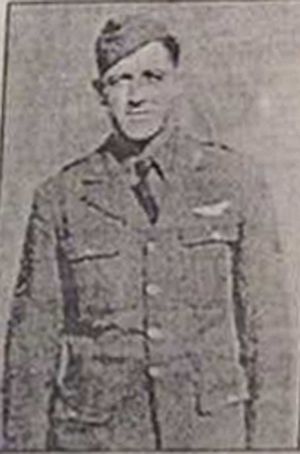
Capt. Norman A. Roggenkamp served as pilot of the aircraft that was lost on 24 June 1944 over the Tréon area south of Dreux, France. The plane was struck by a direct flak hit in the nose at 21,000 feet, causing an immediate fire and explosion. According to bombardier Capt. Schilling, Roggenkamp was seen in the plane at the time of the explosion and did not bail out. His status was recorded as KIA based on Schilling's direct observation.
Lt. Col. Clarence R. Porter served as co-pilot on the mission of 24 June 1944. When the aircraft was struck by a direct flak hit in the nose at 21,000 feet, the plane caught fire and blew up. Capt. Schilling reported that Porter was seen in the plane and was killed in or with the aircraft. His status was recorded as KIA based on direct observation by the narrator.
1st Lt. Morton R. Ashton served as navigator on the aircraft lost 24 June 1944. He bailed out after the plane was struck by flak south of Dreux, France. French contacts reported Ashton's whereabouts as Paris. Capt. Schilling listed him as believed to be evading as of the time of his return to the UK in August 1944. Schilling listed Ashton by name as a person believed to still be evading capture.
Capt. Kenneth W. Schilling was the bombardier aboard the aircraft and the narrator of E&E Report No. 1029. On 24 June 1944 the plane received a direct flak hit in the nose at 21,000 feet, caught fire, and blew up. Schilling bailed out and fell in free fall nearly to the ground before his parachute deployed — the opening jerk pulled his shoes off. He landed in a grain field and ran approximately three kilometers before encountering a French farmer who offered to help him. His helper obtained civilian clothes from a nearby village, and that night they made contact with French Resistance men who had also collected other crew members, most of whom were badly burned. The group was taken to a woods near Cloyes, south of Chateaudun, where they camped for several weeks. The camp grew crowded with British, Dominion, and American airmen, so the Americans were separated into a dedicated camp set up in Freteval Forest, two to three kilometers north of Billeau. The camp was liberated on 13 August 1944 by the 818th Tank Destroyer unit and the evaders were brought to Le Mans. Schilling was interrogated at Rennes by Col. Perry and Lt. Col. Atkinson of 505th HQ, and was subsequently sent by General Lee to Cherbourg, from where he returned to the UK by air on 16 August 1944. He had completed 31 missions and held the DFC, OAC, Air Medal with three Oak Leaf Clusters.
2d Lt. Burl E. Huitt served as ball turret gunner on the aircraft lost 24 June 1944 over the Tréon area south of Dreux, France. He successfully bailed out when the plane was struck by flak and caught fire at 21,000 feet. Huitt evaded capture and returned to duty. His evasion is documented separately as E&E Report No. 1005. He is listed on the crew manifest for E&E No. 1029 as having successfully evaded.
T/Sgt. Adam J. Straczewski served as radio operator on the aircraft lost 24 June 1944 south of Dreux, France. He is believed to have bailed out after the plane was struck by a direct flak hit in the nose and caught fire. French sources reported that Straczewski's whereabouts were Paris. Capt. Schilling listed him as possibly evading as of the time of his return to the UK in August 1944, noting him by name among those believed to still be evading capture. His official disposition was recorded as MIA.
1st Lt. John J. Boyle served as a waist gunner on the aircraft lost 24 June 1944. He bailed out after the plane was struck by flak over the Tréon area south of Dreux, France. French residents reported that Boyle was taken prisoner by the Germans. Capt. Schilling listed him by name among American personnel believed to have been arrested, noting "Boyle, Jake 1st Lt." on his questionnaire. The official crew manifest records him with a disposition of POW.
S/Sgt. Norman Wright served as waist gunner on the aircraft lost 24 June 1944 over France. He bailed out after the plane was struck by a direct flak hit in the nose at 21,000 feet. Wright's official disposition was recorded as MIA on the E&E report crew manifest. One questionnaire form completed by Capt. Schilling lists him as returned to duty, but the official crew roster takes precedence. His ultimate fate at the time of this report was unknown.
S/Sgt. Eugene J. Mlot served as nose gunner on the aircraft lost 24 June 1944. The plane received a direct flak hit in the nose at 21,000 feet altitude, causing an immediate fire and explosion. Mlot was in the nose section of the aircraft when the flak hit occurred. Capt. Schilling noted that Mlot was not seen to jump and was killed in the plane. His status was recorded as KIA, though noted with uncertainty (KIA?) on one questionnaire form, as Schilling could not confirm with absolute certainty that he did not bail out.
S/Sgt. Walter E. Bies served as tail gunner on the aircraft lost 24 June 1944 over the Tréon area south of Dreux, France. He is believed to have bailed out after the plane was struck by a direct flak hit. Bies's official disposition on the E&E report crew manifest was recorded as MIA. One questionnaire form by Capt. Schilling indicates he may have returned to duty, but the official record lists him as MIA. His ultimate fate at the time of the report was uncertain.
T/Sgt. Lowell L. Arnold served as top turret gunner on the aircraft lost 24 June 1944. When the plane was struck by a direct flak hit in the nose at 21,000 feet and exploded, Arnold was seen in the aircraft and did not appear to bail out. Capt. Schilling reported that Arnold was observed in the plane with no parachute visible. His status was recorded as KIA based on this direct observation, though noted with uncertainty (KIA?) on one of the questionnaire forms.
Original documents behind what this page says about this sortie — reports, records, and histories the archive holds and is free to reproduce. Check the sources for yourself.