Recorded Interview
Audio Memoir
The Library of Congress
Audio memoir recorded by The Library of Congress during the opening of the WWII Memorial in Washington DC.
Bombardier · 328th Squadron · Of San Francisco, CA, CA.
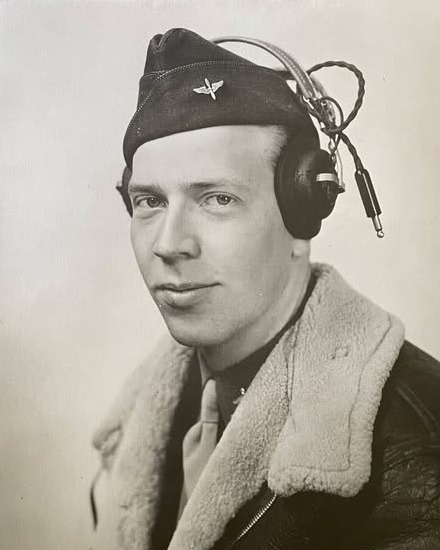
2d Lt. William Hansen (ASN O-741514) served as bombardier on the 7 January 1944 Ludwigshafen mission. The aircraft dropped its bombs with the formation before the engines began failing on the return leg.
Hansen's status was listed as MIA following the crew's bail-out south of Paris. He was captured and became a prisoner of war.
Known as Bill, Hansen recalled in a postwar interview that the crew's B-24, 42-7614, was named Buckeye because three of its airmen came from Ohio. His surname appears as Hassen and Hanson in some wartime records.
Hansen spent two years as a prisoner of war, passing through five camps. Part of that time was in what he called "the death camp," where he was held in solitary confinement for his entire stay. He had been injured when he was captured, and his wounds went untreated there; both legs turned black, and a German doctor told him they would have to come off. He kept them, but the damage would follow him the rest of his life. His last eighteen months were spent at Stalag Luft I, a camp for Allied airmen on the Baltic coast that he said held some 10,000 flyers, most of them Russian, Polish, and British pilots.
For much of that time, the records said he was dead. His family was told he had been killed, and the Air Force carried him on its killed list. Men from his own squadron who later arrived at Stalag Luft I told him so themselves. He eventually managed to get word out that he was alive.
In his interview, Hansen described camp life plainly. Thirty men shared a room, there was almost no heat, and the cold, he said, was what bothered him most. The food came full of maggots and the prisoners ate it anyway. Hansen rigged traps and caught birds, and once in a while one of the German cats; with no way to cook, everything was eaten raw. About every six months the Germans took the prisoners' clothes away for sterilization while the men shaved off all their body hair and washed in a delousing agent that felt like kerosene. The prisoners feared the Gestapo, whose visits meant trouble, but found the older Wehrmacht guards tolerable.
The prisoners organized. They called the guards "goons" and posted a man at the doorway to holler "goon up" when Germans came inspecting, the signal to hide everything. Through trading with the guards they built a hidden radio; Hansen, who did not smoke, traded his cigarettes for radio parts, food, and spices. His job was to follow the war news and pass it through the camp. A skilled map maker, he kept maps showing where the battles were, drawn so that men who got out would know where to go. A repatriated prisoner shipped him seeds through Sweden, and the Germans allowed him a garden patch by the gate where he raised vegetables for the camp. The spot also let him watch new arrivals, since the Germans had a habit of planting informers among them.
Escape work never stopped, and small groups got away. But Hansen recalled that after one large breakout Hitler ordered every escaper hunted down and killed, and of the 55 men who got out, 53 were caught and executed. The prisoners also built quieter routes through captivity. With British prisoners, Hansen helped run a camp school, where he began studying electrical engineering.
By the spring of 1945 the hidden radio told the camp what was coming, and at night Hansen could hear the guns of Marshal Zhukov's advancing army. German soldiers began surrendering to the prisoners inside the wire. When Soviet troops took over the camp, they shot the German soldiers there; Hansen also recalled the Soviet troops' treatment of German women in the area as horrible, and said the prisoners could do nothing to stop it.
An old cadet classmate flew Hansen out, showing him the bombed cities below before delivering him to a hospital in France. Treatment continued at Letterman Hospital in San Francisco, where surgeons opened his damaged arteries and implanted artificial ones in both legs, running from foot to belt line. The engineering course he had started behind the wire continued too: degrees from the University of California, and a career with Pacific Gas and Electric.
The missions below are those we have been able to document for this airman, drawn from flight logs, mission records, and archival sources. It is not necessarily a complete account of every mission flown; gaps may reflect missing documentation, transferred assignments, or records lost to time.
Continued the electrical engineering studies he had begun in a POW camp school, earning degrees from the University of California and spending his career with Pacific Gas and Electric. Underwent repeated vascular surgeries stemming from his untreated POW leg injuries, beginning with angioplasty and artificial arteries implanted at Letterman Hospital, San Francisco.
Audio memoir recorded by The Library of Congress during the opening of the WWII Memorial in Washington DC.
Original documents behind what this page says about this airman — reports, records, and histories the archive holds and is free to reproduce. Check the sources for yourself.