Walter F. Hughes.
Pilot · 330th Squadron · Of Santa Barbara, CA.
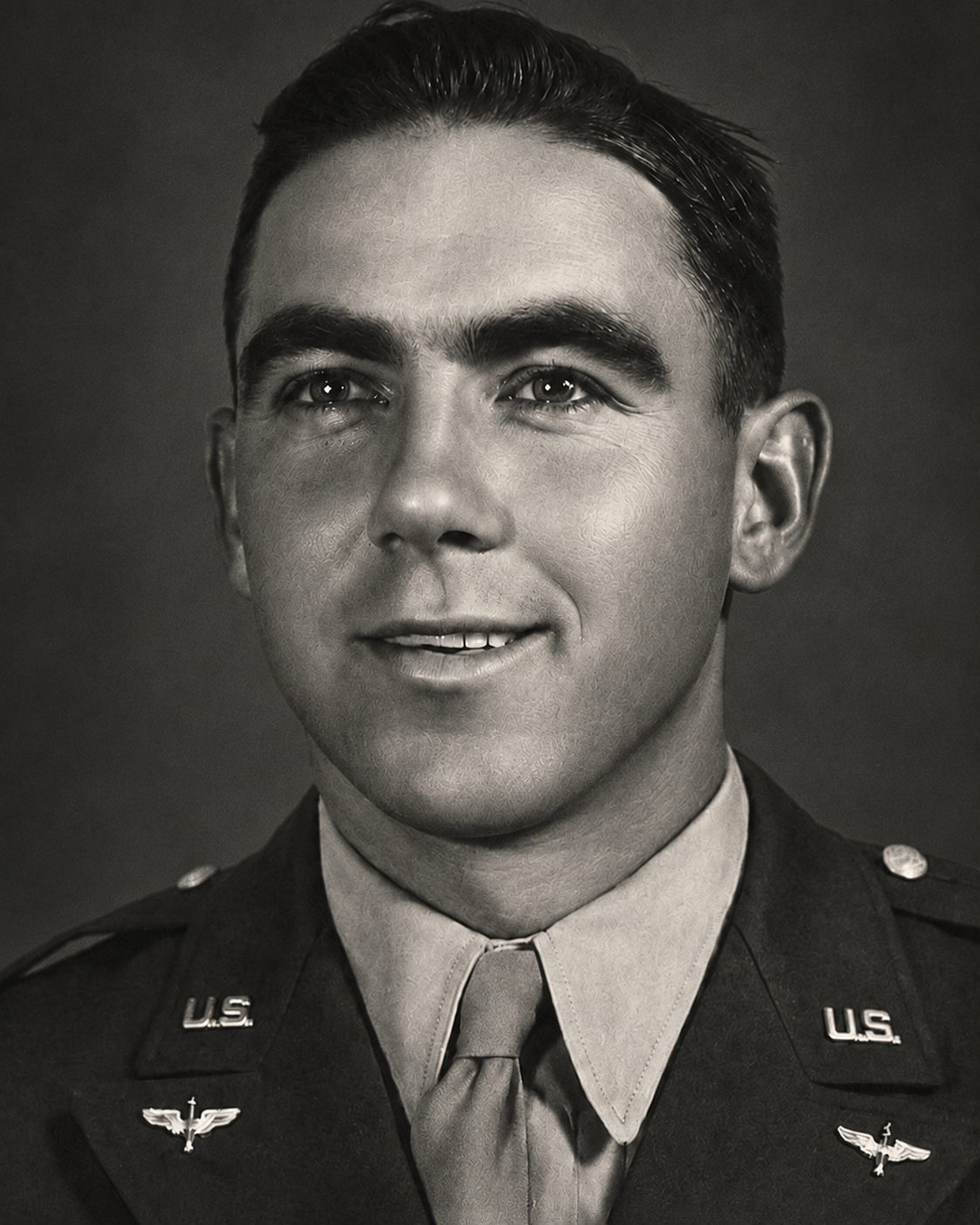
The Man Behind the Name
Walter F. Hughes grew up in the Santa Barbara area of California, graduating from Santa Barbara High School in January 1940. His family faced the financial realities of the Depression era: with three sons close in age, they could not afford to send all three to college simultaneously. To solve this, the brothers rotated college attendance, funding their education through income from a 4-H Dairy Project. Walter's older brother Elmer graduated in 1939 and headed to UC Davis Agricultural School, while Walter took over the daily milking duties. When Elmer returned, Walter enrolled at UC Davis in September 1941, leaving his younger brother George to tend the cows. The arrangement was rooted in the kind of cooperative self-reliance that shaped Hughes's character throughout his life.
The attack on Pearl Harbor on December 7, 1941, brought the war immediately into focus for the family. A few weeks later, a Japanese submarine surfaced off the California coast and shelled the oil fields at Elwood, sending shell fragments into the very pasture where the family's dairy cows were kept. No cows were hurt, but as Hughes later wrote, "suddenly the war got close." His older brother Elmer was drafted in January 1942. George wanted to enlist. The cows were sold. In June 1942, Hughes traveled to the naval air station at Oxnard, California, to enlist in the Naval Air Corps. He passed the written examinations despite having only one year of college, but was rejected on a medical technicality: his front teeth did not meet, and naval pilots were required to maintain a seal on their oxygen supply tube between breaths. Disappointed but undeterred, he drove to Santa Ana a few days later and enlisted in the Army Air Forces. He received his call-up orders in late January 1943 and reported to Santa Ana Army Air Base by noon on February 11, 1943, carrying little more than a grooming kit and a change of clothes.
The selection process at Santa Ana was rigorous and designed to wash out the majority. Hughes underwent psychological screening, two trips in a decompression chamber, extensive color blindness testing, and a battery of physical and mental aptitude tests. He excelled in physical fitness and chose pilot training despite its higher washout rate. Assigned to class 44-A at Thunderbird Field No. 2 outside Scottsdale, Arizona, he took his first airplane ride in the Stearman biplane, soloed after 9.5 hours, and graduated primary training with 40 flight hours. He moved on to basic training in the BT-13 Vultee Vibrator at Minter Field near Bakersfield, California, then advanced twin-engine training at Marfa, Texas, in the UC-78. He received his gold bars and wings at graduation on January 7, 1944, as a newly commissioned second lieutenant.
After ten days of leave, Hughes transferred to Kirkland Field in Albuquerque, New Mexico, for B-24 Liberator transition training. His first sight of the aircraft made an impression: four engines totaling 4,800 horsepower and a 110-foot wingspan. He found the B-24 highly responsive and studied every system thoroughly. In spring 1944 he was assigned his combat crew at Hammer Field in Fresno, California. The ten men of Crew 94-A included copilot Second Lieutenant Peter Scott, navigator First Lieutenant Louis Windsor, bombardier Second Lieutenant Ralph Hendershot, engineer and top gunner Corporal Conway Thorstenson, radio operator Corporal Norbert Ecclesfield, and gunners Boyd Justice, Robert Lee, Michael Kusnir, and Carroll Ruby. The crew trained together at March Field near Riverside, California, surviving several close calls before ever leaving for combat.
The crew departed Hamilton Field near San Francisco on July 30, 1944, aboard a brand-new B-24 valued at $237,000. They flew north through Goose Bay, Labrador, were diverted to Greenland when Iceland was socked in, and finally crossed to Valley, Wales. On August 21, 1944, Hughes and his crew reported to the 330th Bomb Squadron of the 93rd Bomb Group at Station 104, approximately 18 miles southwest of Norwich, in the flat farmland of East Anglia. The 93rd, part of the 2nd Air Division of the 8th Air Force, was known informally as "Ted's Flying Circus" and had one of the longest combat records in the theater.
Between September 10, 1944, and April 8, 1945, Hughes flew 35 combat missions over occupied Europe and Germany. Targets ranged from marshaling yards and oil refineries to canal locks, ordnance depots, and enemy troop concentrations. His fourth mission, a raid on a tank factory at Kassel, ended with his rudder and elevator control cables shot through by flak, requiring him to fly back to England on autopilot with bomb arming wires improvised into the severed cables. He served twice in the deputy lead role for his squadron, and five missions in seven days in early November 1944 left the crew, as Hughes put it, "weary, tired almost beyond endurance."
The defining moment of Hughes's combat tour came on November 21, 1944, over Hamburg. With an estimated 446 guns defending the target and nearly twelve minutes of continuous flak, the 93rd flew through on a clear day that improved accuracy but left every aircraft fully exposed. After bombs away, as the formation began its right turn, copilot Peter Scott was struck by a fragment of an antiaircraft shell. Hughes looked over to see his copilot staring back at him with only surprise in his eyes before beginning to slump into the control wheel. With help from radio operator Ecclesfield, Hughes got Scott onto the flight deck and flew home with engineer Thorstenson in the copilot's seat. The squadron doctor confirmed that Scott had been killed by a piece of shell roughly three-quarters of an inch square that had clipped the right subclavian artery in a gap in his flak vest. He had bled to death in under a minute. Hughes accompanied Scott's body to the American military cemetery at Cambridge. The memoir Hughes later wrote is dedicated to him.
The missions continued through the winter and into spring. On March 24, 1945, Hughes flew a low-level supply drop in support of Montgomery's Rhine crossing, navigating a nine-ship formation at seventy-five feet with wing tips nearly overlapping. His plane dragged a wing tip on the ground after being crowded out of position, made two additional passes under rifle and cannon fire, and landed with twigs from hedgerows packed into every engine nacelle. On April 7, a delayed-action 20-millimeter shell penetrated the cockpit, threw Hughes into the control wheel hard enough to break his seat belt, wounded the replacement copilot, and sent a fragment near Ecclesfield's hip. Stacks of flak vests left by a previous crew under Hughes's seat were credited with saving his life. His final mission was flown on April 8, 1945, against an airfield at Roth near Nuremberg. In total he had been briefed eighty-six times, taken off on forty-six missions, and completed the thirty-five required for his tour.
Hughes returned to the United States aboard the SS Franconia in May 1945 and was processed at Fort Dix. On July 24, 1945, he married Violet Sasso, a WAC officer he had met at March Field, at the post chapel there. The two had been introduced at the wedding of bombardier Ralph Hendershot, where Hughes served as best man and Violet as maid of honor. He was officially separated from active duty on June 12, 1945. He noted with some bitterness that the separation center could not issue him a private pilot's license based on his military flying record, and that by the time he tried to pursue one six months later, he could no longer afford the required lessons. He had become, by his own account, very good at flying, and never flew again.
In the closing lines of his memoir, compiled from notes written between 1945 and 1950, Hughes reflected on what the war had cost: "I had learned a skill at an expense of about $20,000, one at which I was DAMM good and which I never again used. Such is the waste of war, and even worse nothing was solved. My conclusion about this episode: the utter folly, the utter stupidity of human beings shooting at each other." The memoir was archived at the Norfolk Record Office in England under the reference MC 371/112, held in the collection of the 2nd Air Division of the 8th Air Force. Hughes also supported the 2nd Air Division Memorial Library in Norwich. His navigator, Louis Windsor, preserved a meticulous log of all thirty-five missions. Bombardier Ralph Hendershot wrote Hughes a letter in June 1983 confirming many of the details, including a quiet moment on the morning of the Hamburg mission when Pete Scott sat against a building in the early light, said he was tired, and wished he did not have to fly that day.
From the 2nd Air Division Association Yearbook
Assigned to 330th Sqdn., 93rd Bomb Group, August 1944. First mission Sept. 10, 1944; completed 35 missions with last mission on April 8, 1945. Co-pilot Lt. Peter Scott was killed over Hamburg on Nov. 21, 1944; two crewmen injured during a fighter attack on the 34th mission (April 7, 1945). Crew participated in low-level resupply missions to Montgomery's Rhine River Crossing on March 24, 1945.
Service record.
Missions flown.
The missions below are those we have been able to document for this airman, drawn from flight logs, mission records, and archival sources. It is not necessarily a complete account of every mission flown; gaps may reflect missing documentation, transferred assignments, or records lost to time.
Before and after.
Born Jan. 27, 1922 near Goleta, CA. Enlisted in the Air Corps in July 1942. Pilot Class 44-A, Marla, TX, January 1944. Flew new B-24 from Hamilton Field, CA to England.
Discharged June 10, 1945 as first lieutenant. Earned Distinguished Flying Cross, Air Medal with seven Oak Leaf Clusters, and Unit and Theater decorations. Married WAC Cpl. Violet Sasso at March Field on July 24, 1945; three children, two grandchildren. Was a veterinarian specializing in Avian Medicine; retired 1990.