Jack W. Earnshaw.
Engineer / Top Turret · King Crew · 330th Squadron
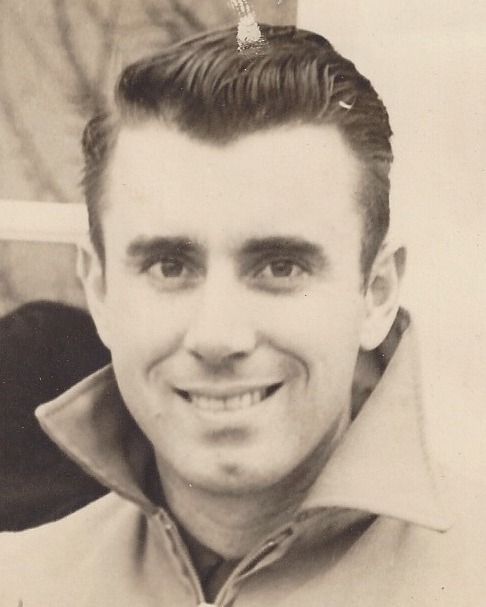
The Man Behind the Name
Jack W. Earnshaw graduated from Baltimore City College in 1942, right as the country was settling into the war. He spent that summer working in a shipyard, then went on to college, where he and several friends enlisted together in the Army Air Forces. Like a lot of young men his age, he was drawn to the Air Force for its reputation as the "glamour" branch, with faster promotions and more specialties to choose from.
After basic training in Miami Beach, mechanic school in North Carolina, and gunnery school in Florida, Jack came together with his crew in Charleston, South Carolina, where they trained on the B-24 Liberator for about a month and a half. He served as flight engineer, the crew's senior enlisted man, responsible for the plane's systems in flight and doubling as the top turret gunner once over enemy territory.
The crew shipped out for England at the start of October 1944, crossing alone aboard the Queen Mary rather than in a slower convoy. They landed at Greenock, Scotland, and Jack never forgot the sight of it: an old castle on the bluffs, dark clouds racing behind it, and a bay crowded with warships from a dozen nations. From there they went by train to Norfolk and joined the 93rd Bomb Group's 330th Squadron at Hardwick, part of the 8th Air Force's 2nd Bomb Division, as a replacement crew. The welcome was blunt. Moving into their Nissen hut, they learned they'd be sleeping in the beds of a crew that had just been shot down. Jack kept a page from a 1944 Yank magazine that the previous crew had used as a calendar, marking off their missions day by day until the date they didn't come back. He picked up the same calendar and kept marking it himself for the rest of the year.
Jack flew his first combat mission in early November 1944, a run against the marshalling yards at Rheine that turned out to be a relatively easy introduction to combat. Tougher missions followed, including a heavily defended raid on Magdeburg and one to Osnabrück where flak knocked out the plane's hydraulics, electrical power, and oxygen system all at once, forcing an emergency descent so the crew could breathe. They straggled home so far behind the rest of the group that they were briefly reported missing in action. As flight engineer, Jack spent takeoffs and landings wedged between the pilot and co-pilot calling out airspeed and checking the wheels and flaps, and more than once he hand-cranked the bomb bay doors or landing gear closed when the hydraulics failed. In the air over Germany, he manned the top turret's twin .50-caliber guns, wearing a bowl-shaped helmet because a standard flak helmet wouldn't fit in the turret, with flak jackets laid across the floor around him for whatever protection they could offer.
Life on the base had its own rhythm between missions: pre-dawn walks to the mess hall under clear, star-filled blackout skies, tense briefings where veteran crews could read the mood of the room by the target on the map, and evenings at a tiny two-room pub in the village that Jack and his crewmates preferred to the one on base. About halfway through his tour, the crew was sent to a country estate near Reading for a week of rest, riding bikes and horses and fishing in civilian clothes. Not everything that grounded the crew was combat-related — their pilot, Donovan King, once got bitten by dogs in London badly enough that an infected thumb kept the whole crew out of the air for a week, a stroke of bad luck that turned out lucky, since the squadron took heavy losses during that same stretch.
Jack's most memorable flight wasn't a combat mission at all. On VE Day, a new squadron commander who'd clashed with King ordered the crew into the air for a training flight while the rest of the base celebrated on the ground. It turned into an unforgettable night: for the first time, England's blackout lifted, and Jack watched bonfires light up the countryside from Wales to Scotland as the crew traded flares with people on the ground and switched on every light on the plane. When the war in Europe ended, the crew voted unanimously to go home together rather than stay on occupation duty, and the war against Japan ended before they could retrain for the Pacific.
Jack came home, finished his education at Washington College, and spent his career in Baltimore County Public Schools, teaching for four years before becoming a principal for 27 years until his retirement in 1977. Along the way he had a second brush with history: as a sixth-grade teacher on a class trip to Washington in the early 1950s, he and about 40 of his students were sitting in the House gallery on March 1, 1954, when four Puerto Rican nationalists stood up, unfurled a flag, and opened fire on the House floor.
Decades later, Jack reconnected with his old crew after the tail gunner tracked down their addresses, and he visited them in Illinois, Missouri, and Arizona. He also struck up a correspondence, and eventually a friendship, with a German veteran who had been a 15-year-old schoolboy manning a flak battery near Magdeburg during the very raids Jack flew. The two hosted each other decades after the war, visiting an aerospace museum together and talking about anything but the war itself.
Service record.
Missions flown.
The missions below are those we have been able to document for this airman, drawn from flight logs, mission records, and archival sources. It is not necessarily a complete account of every mission flown; gaps may reflect missing documentation, transferred assignments, or records lost to time.