“War Baby/Ball of Fire Jr.”
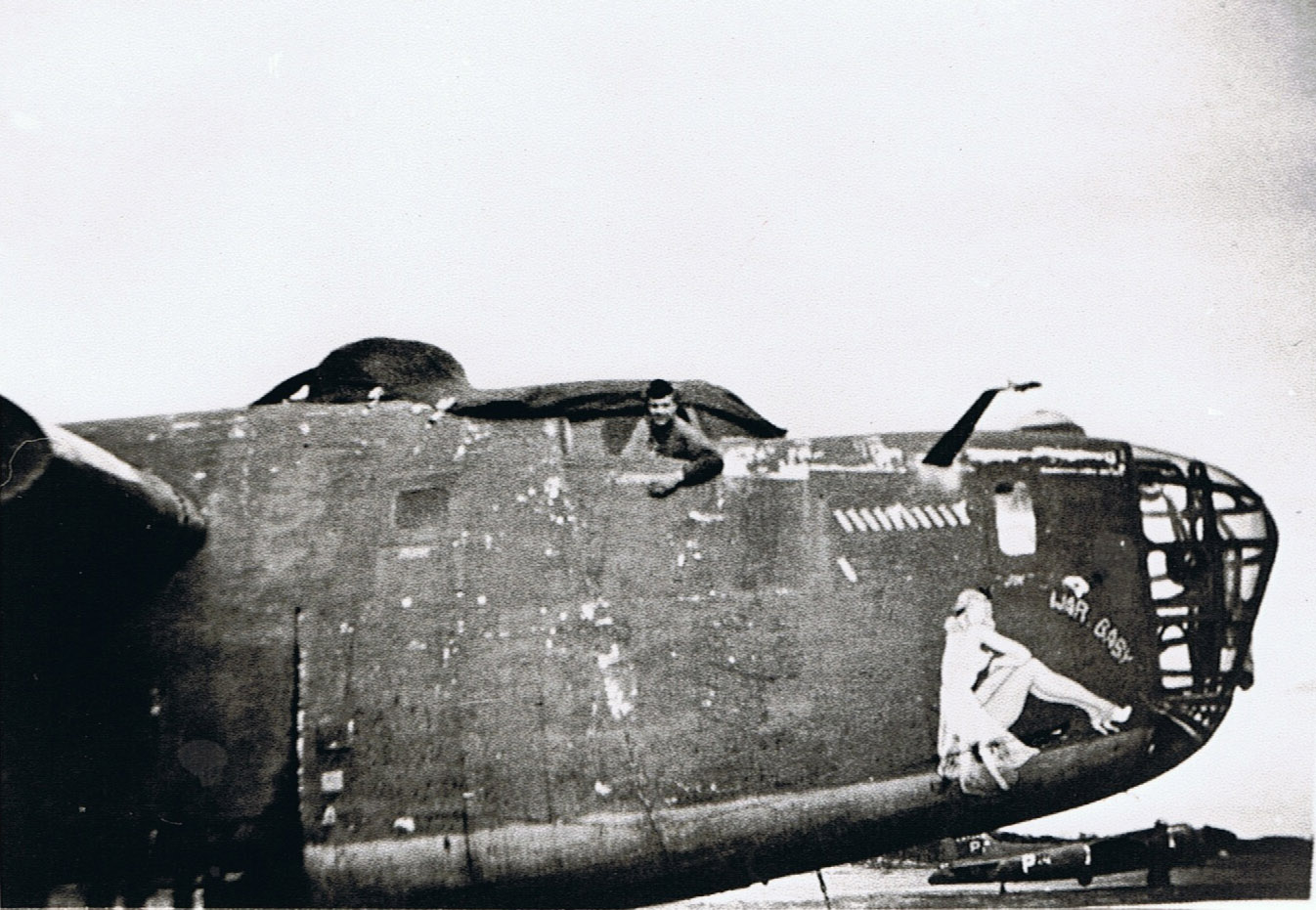
Ball of Fire Jr. led the second Circus wave across the Ploesti target on August 1, 1943, with squadron commander Joe Tate at the controls. She came off the refinery remarkably untouched, though her tail gunner watched a rooftop flak position vanish in an explosion moments after firing on the formation - and, harder to shake off, saw a burning B-24 climb, two parachutes open, and both drift down into the spreading fire below.
A few nights later at Terria, Tate re-lived the raid in a violent nightmare, imagining a low-level attack in which his gunners were wounded; he tore his shirt into tourniquets and shouted for bandages before waking his tentmates to find his pajamas and mosquito netting in shreds. His friends later joked that the shredded netting should be classified a battle casualty, and that Tate deserved a Distinguished Flying Cross for his solo dream mission.
On the morning of November 18, 1943, the aircraft (by then known as "War Baby") lifted off from Hardwick as part of a massive 8th Air Force strike against a Luftwaffe repair depot outside Oslo, after unplanned hits on a German seaplane base near the Norwegian-Swedish border. It was her twelfth mission. The attack came off well, formations of nearly 100 aircraft hitting the target from 12,000 feet in clear skies. The trouble came on the way home.
Barely past the Norwegian coast, a force of Messerschmitt Bf 109s and Junkers Ju 88s intercepted the returning bombers. In the air battle that followed, six Liberators went down. Three more, War Baby among them, took damage too severe to risk the long water crossing back to England.
Her pilot, 1Lt F. Kilcheski, turned south toward neutral Sweden.
After circling the city of Örebro for some time, and dropping an ammunition belt over nearby Lake Hjälmaren, War Baby touched down on a small grass airfield at 13:25. The field at Gustavsvik measured roughly 200 by 200 meters, a postage stamp by any bomber standard. Kilcheski and his crew moved quickly to destroy the aircraft, dousing it with fuel and firing signal flares into it, but Swedish police and a guard who had pedaled out on his bicycle managed to stop them before the fire took hold.
The crew of ten, several suffering frostbitten cheeks and feet, were taken to the police station where the Swedes arranged a hot meal and a bath. The next morning they were transported by taxicab to an internment hotel in Dalarna.
War Baby sat at Örebro through the early winter, propped on wooden pallets to keep her from sinking into the clay. Swedish engineers built a timber bridge over a creek at the eastern end of the field to lengthen the runway. On December 16, 1943, Kilcheski and his crew returned, with Swedish Air Force personnel alongside, and flew her out to Västerås on the original field, not even using the extension. It was her last flight.
Twelve missions. Eleven bomb symbols on the nose, and one extraordinary end in a Swedish meadow.