“Baggy Maggy”
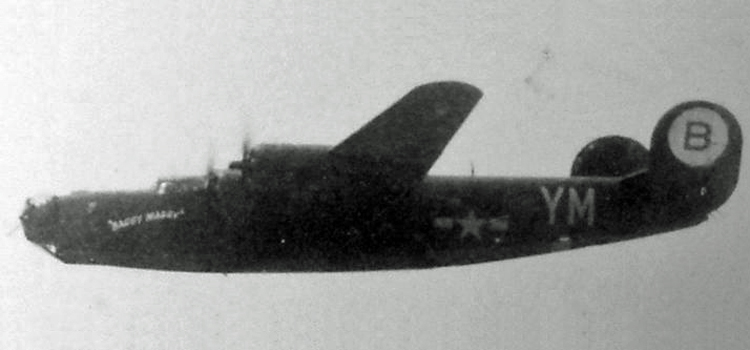
B-24J serial 42-100416, nicknamed 'Baggy Maggy' (recorded as 'Baggie Maggie' in MACR 9810), served with the 409th Bomb Squadron, 93rd Bomb Group at Hardwick, England, and had been with the Group since at least mid-1943, including the Ploesti raid. Multiple crews flew her over more than a year of combat; one veteran of her 1943 missions, Jim McMahon, called her 'about the best plane in the 93rd' -- 'she always ran like a sewing machine.'
On 18 September 1944, during Operation Market Garden, the crew of pilot 2nd Lt. Larry M. Hewin flew Baggy Maggy on a low-level resupply drop to Allied airborne forces near Arnhem, the Netherlands. Several of the ten men aboard that day were last-minute substitutes for the regular Hewin crew, including flight engineer Donald Dukeman (filling in for T/Sgt. Frank Wathen, who had broken his arm in a bicycle accident) and navigator Henry Greenberg (filling in for 2nd Lt. Wilmer Landon, on training duty). After pulling up to about 500 feet to make the airdrop, the aircraft was hit by heavy ground fire, including 20mm flak, wounding Hewin and other crewmen.
With Hewin badly wounded, co-pilot 2nd Lt. Richard C. Scott and bombardier 2nd Lt. George W. Sadler flew the crippled aircraft at treetop height, clearing hedgerows one at a time, before crash-landing in a field near Castelré. Radio operator T/Sgt. William Kirlin Jr. was killed, crushed when the top turret collapsed onto him in the crash; the rest of the crew survived and became prisoners of war. Pilot Hewin was liberated at war's end and later recounted the mission in detail.
The crash site on the Hoogstratensebaan near Castelré was first marked in September 1945, on the first anniversary of the crash, by a wooden cross erected by local policeman Adriaan Van der Hoeven and unveiled by the mayor of Baarle-Nassau; that marker deteriorated and disappeared by the mid-1950s, leaving the site unmarked for decades. Beginning in the early 1990s, Dutch amateur historian Jos van Roozendaal (1945-2024) of Ulicoten researched the crash and located the surviving crew, reuniting them by correspondence after 47 years of lost contact and bringing about the bronze-plaque monument that stands at the site today. An annual memorial ceremony is held there; the 1994 50th-anniversary dedication and the 2004 60th-anniversary ceremony (attended by Kirlin's sister, Gertrude Stuber-Kirlin) are both documented, though surviving accounts disagree on exactly which crew members were present in 1994. In 2017 and again in 2024, the two sons of navigator Henry Greenberg -- who, like his crewmates, had never spoken of the crash -- separately visited the memorial after discovering their late father's record, closing the last open thread in what researchers describe as one of the best-documented American bomber losses in the Netherlands. Van Roozendaal's children, Karin and Koen (a KLM 777/787 captain), continue to be involved with the memorial's upkeep since his death in January 2024.